


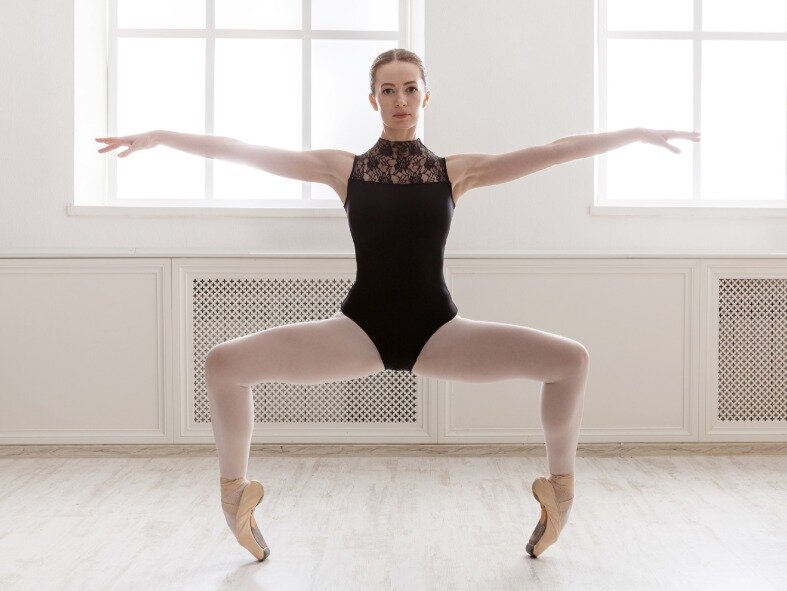
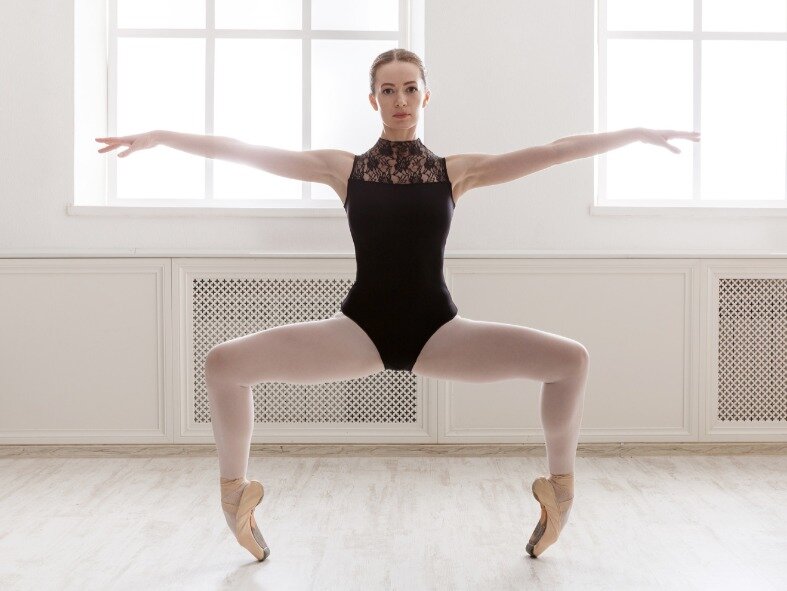
Plié is one of the fundamental movements of classical dance.
Improving your plié is a great way to improve your technique and overall performance, because almost all dance movements are built starting from “simple” elements like plié and battement tendu.
So here are 3 practical strategies to help you achieve a deeper, more efficient plié.
I’m Maddalena, founder of the project La Clinica della Danza, and I help students and dancers improve their technique starting from knowledge of anatomy and the intrinsic dynamics of movement.
Alignment and posture
The first step is to focus on your alignment.
Picture a dancer in profile and imagine a vertical line running through the center of their ears, shoulders, abdomen, pelvis and ending at their point of support on the floor: the feet.
Pelvis in a neutral position and an active core are the first two essential elements for a good plié.
At this point, find your best en dehors. Don’t force the rotation from the feet; instead, deeply activate the external rotator muscles that sit under your gluteus maximus.
Speaking of en dehors: the shape of the coxofemoral joint (the hip) is such that when flexion occurs, the femur has more ability to externally rotate.
In plain words... what does that mean?
You may have noticed that when you do a grand plié you can get a better turnout, which you tend to lose when you straighten your legs.
So try to take advantage of this anatomical feature to feel your maximum openness and en dehors and, when you straighten your legs, try to work muscularly so you don’t lose it.
Use the eccentric contraction of your muscles
Muscles can perform three types of contraction:
Eccentric contraction
Concentric contraction
Isometric contraction
To give the plié its characteristic resistance, what you need is to master eccentric contraction.
A “soft” plié with little resistance is in fact completely useless for preparing any dance step.
It won’t help you push correctly during jumps, it won’t give you the right energy in relevés, and it won’t help you cushion the landings of jumps and pirouettes.
How do you perform a plié with eccentric contraction?
Before you start bending your legs, activate your quadriceps by thinking of straightening your legs as much as you can and drawing the kneecap upward.
At this point you’re ready to do an excellent eccentric plié, gradually releasing your muscles. For an even better result, exhale as you perform the movement.
Use resistance bands
I’m a huge fan of small tools that allow us to do specific floor exercises for dance steps by stimulating the right muscles.
If I really had to choose one tool that should never be missing from my bag, it would be the loop resistance band.
So here are two great exercises to improve your plié with the loop resistance band.
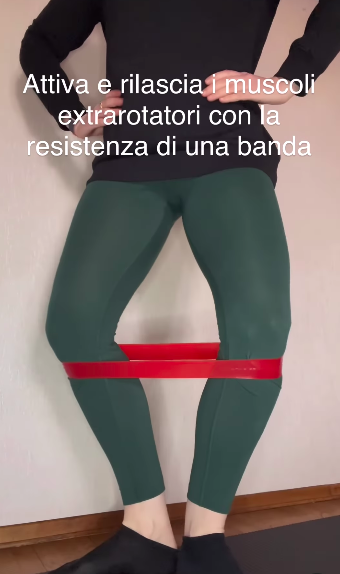
Pliè in en dehors
Place the band just below the knees
Perform a pliè
Engage the external rotators, trying to open your knees as much as you can, and hold for 5 seconds
Release
Repeat 10 times
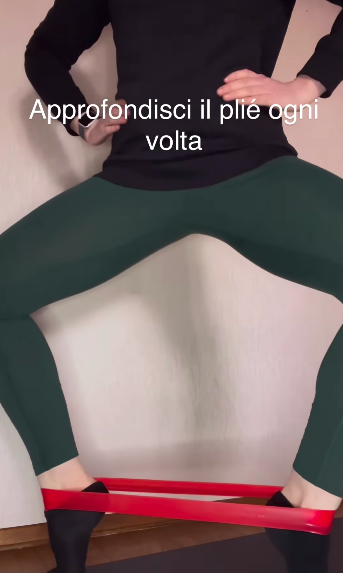
Plié progression
Place the elastic band around your ankles and stand in second position
Do a plié and then lift your heels, coming up to demi-pointe
Deepen the plié
Try to bring your heels to the floor without lifting your pelvis back up
Repeat 5 times
Next time you step up to the barre, ready for the first pliés of class, make sure you focus 100%. Those pliés will shape how you tackle the whole lesson.
Would you like to explore the topic further or follow new ones?
Maddalena from Clinica della danza is waiting to give you lots more information and tips on how to improve your plié.